
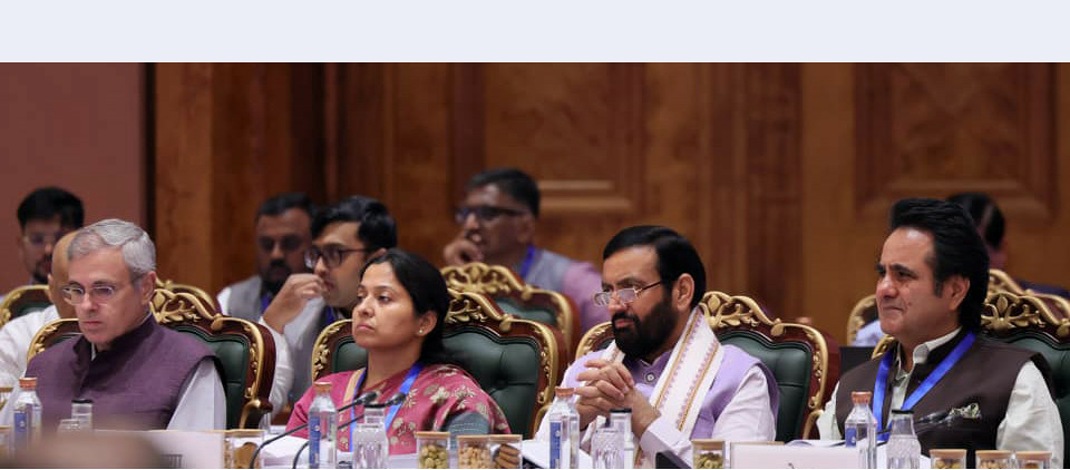
New Delhi : Haryana Chief Minister Nayab Singh Saini on Thursday attended the 57th meeting of the Goods and Services Tax (GST) Council, chaired by Union Finance Minister Nirmala Sitharaman at Bharat Mandapam in New Delhi.
Highlighting Haryana’s contribution to the national economy, Saini said that despite accounting for only around 1.3 per cent of the country’s geographical area and nearly 2 per cent of its population, the state recorded gross GST collections of ₹10,097 crore in September 2026. This was the fifth-highest collection among all states and accounted for more than 7 per cent of the country’s domestic GST revenue.
During the meeting, the Chief Minister put forward three proposals aimed at easing compliance, improving coordination between tax authorities and protecting the interests of genuine taxpayers.
One-time relief for delayed GST appeals
Saini proposed granting a fresh, one-time opportunity to file appeals against orders relating to the initial years of GST implementation—financial years 2017-18 to 2019-20.
He pointed out that a limited window for filing such appeals had earlier been provided in November 2023. In Haryana, 646 cases involving demands of ₹567.43 crore were rejected solely because the appeals were filed late.
According to Saini, many of these taxpayers want an opportunity to have their cases examined on merit. He urged the Council to consider a more comprehensive one-time relief covering demands involving tax, interest and penalties, including cases where the demand consists solely of interest or penalty and does not include any tax component.
He suggested that the Council could consider recommending a special procedure under Section 148 of the CGST Act for implementing this limited relief.
Call for better coordination between Centre and states
The Chief Minister’s second proposal focused on coordination between Central and State GST authorities during enforcement proceedings.
He said taxpayers sometimes face summons, investigations, inspections and other proceedings from both tax administrations on the same or interconnected matters. This can result in repeated submission of documents and additional expenditure of time and resources.
Saini called for a clear and practical mechanism to ensure administrative coordination while preserving the legitimate enforcement powers of both the Centre and the states.
Haryana proposed the creation of a technology-enabled mechanism to facilitate such coordination.
Proposal to protect genuine buyers’ input tax credit
Saini also raised the issue of retrospective cancellation of GST registrations.
He said the existing law allows authorities to cancel a registration from a date determined by them. He proposed that such powers should be subject to a safeguard: where there is evidence that the taxpayer supplied goods or services during a particular period, the registration should not be cancelled retrospectively for that period.
He said retrospective cancellation could put the input tax credit (ITC) of genuine buyers at risk, particularly those who had purchased goods or services from the taxpayer during the relevant period.
Haryana welcomes proposed GST reforms
The Chief Minister said Haryana welcomed the reforms being considered by the GST Council, describing them as steps towards a more technology-driven and risk-based tax administration.
He supported greater automation in registration, amendments, cancellation and refund processes, saying technology-based systems could reduce the workload of tax officials and allow them to focus more on preventing tax evasion.
According to Saini, such measures would also improve transparency and make compliance easier for genuine taxpayers.
He further welcomed the proposed simplified registration process for small taxpayers supplying goods through e-commerce operators, along with a system-based risk assessment mechanism for processing refunds.
GST revenue rises 22 per cent in 2025-26
Saini said Haryana’s state GST revenue, including the state’s share from IGST settlement, increased from ₹39,743 crore to ₹48,289 crore in 2025-26, registering a growth of 22 per cent.
He said this was the highest growth recorded among states, compared with a national average of 6 per cent.
During the first six months of the current financial year, Haryana’s state GST revenue reached ₹29,108 crore, compared with ₹23,058 crore during the corresponding period of the previous year. This represented a 26 per cent increase, the second-highest growth among states, against a national average of 16 per cent.
The Chief Minister attributed the growth to the efforts of Haryana’s industrialists, traders and service providers, as well as the state’s compliant taxpayers.
He said the state government was taking further steps to strengthen tax revenue and had organised a national conference on strengthening Haryana’s tax revenues in Chandigarh on September 30.
Lower tax rates and higher revenue can go together
Referring to the GST rate rationalisation implemented from September 22, 2025, following recommendations of the GST Council, Saini said tax rates were reduced on several sectors and products, including motor vehicles and auto components, tractors and agricultural machinery, cement, electronic goods, textiles, food products, daily-use items and medicines.
Life and health insurance were also exempted from GST, he noted.
While there had initially been concerns about the impact of lower rates on revenue, Saini said Haryana’s experience over the past year had shown encouraging results.
He said the turnover of taxpayers in sectors where GST rates were reduced had increased by 33 per cent compared with the previous year. Turnover in tractors and their components rose by 52 per cent, while auto components recorded a 46 per cent increase.
He noted that Haryana is a major automobile manufacturing hub and said the impact of the tax relief was particularly significant for the state. According to him, the benefits had reached farmers, middle-class families and small traders and had subsequently translated into higher demand in the economy.
Haryana reiterates commitment to Viksit Bharat 2047
Saini said Prime Minister Narendra Modi’s vision of building a Viksit Bharat by 2047 required states to strengthen their economic capacity, increase revenue and ensure more efficient use of public resources.
He described GST as an important example of cooperative federalism and said reforms that simplify compliance for honest taxpayers while protecting revenue would contribute to the country’s long-term development goals.
The Chief Minister assured the GST Council of Haryana’s continued cooperation and said the state would work with the Centre and other states under the guidance of the Prime Minister and the leadership of the Union Finance Minister towards the goal of Viksit Bharat 2047.